
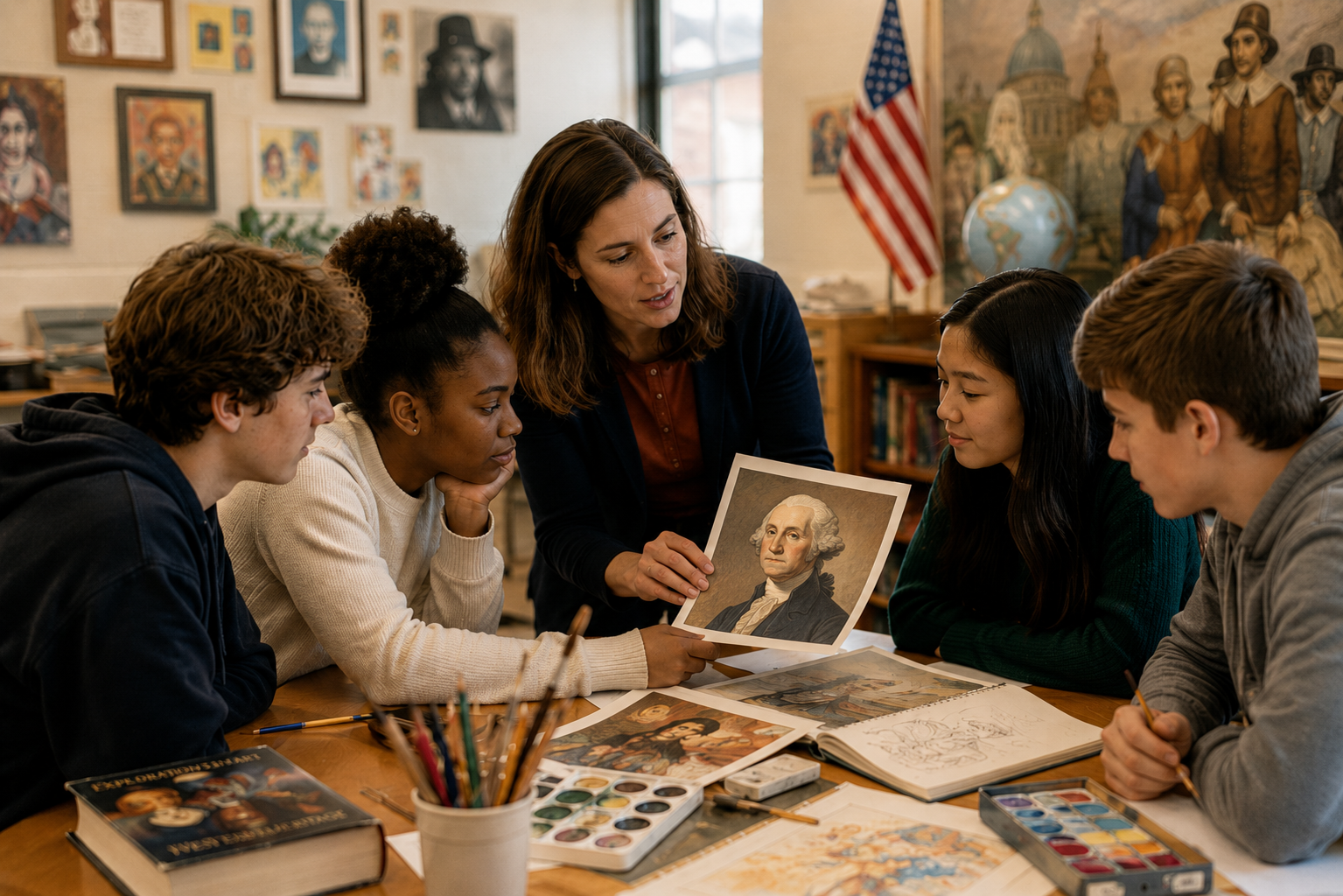
A strong education should teach students to read, calculate, reason, and communicate. It should also train them to notice beauty, make something with care, and understand the stories that shape a people. Creative arts in K-12 education belong in that larger work because education is preparation for responsible citizenship.
Art asks a young person to pay attention, make choices, and try again. Those habits cultivate patience and judgment, qualities free citizens need if self-government is to remain more than a constitutional theory.
Art trains attention and judgment
In our recent podcast conversation, we considered the place of visual art in education and the challenge of preserving human creativity as technology improves. Josh Nelson, digital illustrator, offered two ideas worth carrying into the classroom: making art develops skill and judgment that an instantly generated image cannot supply, and visual portrayals of historical figures can give students a memorable entry point into lives marked by courage, sacrifice, and service.
That matters in citizenship education. At Heritage, students study American figures through their writings, actions, and historical setting, while visual art gives them another way into the story. The goal is to compare ideals with conduct, understand human struggle, and develop constitutional literacy, a working knowledge of constitutional structure and principles.
Civic memory needs visible forms
Thomas Jefferson explicitly connected public architecture with civic culture early in the republic. In a 1785 letter to James Madison about Virginia’s Capitol, Jefferson argued for a classical design that citizens could study and imitate. He also noted that the proposed design was more convenient, provided more room, and would cost no more than two-thirds as much as the alternative.
Jefferson did not treat beauty, usefulness, and economy as competing goals. He wanted public buildings to improve public taste while making responsible use of public money. Schools make similar choices about what students see, hear, read, and remember.
What hangs on a classroom wall communicates something. So do the music students perform, the literature they read, and the historical figures a school chooses to study. A school cannot avoid transmitting culture. The wiser task is to do so thoughtfully, with parents and local educators exercising judgment.
That is also an argument for local responsibility rather than distant mandates. Families and local educators should have room to choose traditions that reinforce their school’s mission while respecting shared constitutional principles. Local control places responsibility closer to the people who live with the results.
Drawing is a way of thinking
One practical idea we discussed was simple: open a notebook and draw the relationships you are trying to understand. Sketching is not merely a way to make attractive pictures. It can be a method of reasoning. A diagram can expose an assumption hidden in prose, while a rough drawing can make a scientific or mathematical relationship visible.
The arts therefore should not be treated as enrichment that begins after the serious subjects are finished. Science, engineering, history, and art all depend on close observation and representation. Students who learn to notice relationships and put them on paper gain another tool for discovery.
A randomized controlled trial involving 10,548 students in grades 3 through 8 at 42 Houston schools gives us useful evidence. Increased arts-learning experiences reduced the share of students receiving disciplinary infractions by 3.6 percentage points, improved STAAR writing achievement by 0.13 standard deviations, and increased a survey measure of compassion for others by 0.08 standard deviations.
The findings deserve proportion. They do not show that art raises achievement in every subject or that every program will produce the same effects. But because schools were assigned by lottery, the study offers stronger causal evidence than a simple comparison between students who choose arts programs and those who do not.
Keep technology in its proper place
Generative artificial intelligence is technology that produces new text, images, audio, or other content from patterns learned from large bodies of existing material. Schools should teach students to use it responsibly, including the questions it raises about authorship, intellectual property, honesty, and human effort.
A free society should not fear useful innovation. Free markets and technology have always changed tasks and tools. AI may become a powerful catalyst for artists, scientists, engineers, and students, but assistance should not replace learning how to observe, practice, revise, and create.
Speed creates its own temptation. A student can generate an image in seconds, while learning to draw well may take years. Education should not be organized around eliminating every difficult process. Some capacities develop precisely because mastery requires patience.
Schools and families form habits together
The arts are strongest when schools and families treat them as part of forming the whole person. Young people should draw, paint, sculpt, perform, build, listen, and study excellent work. They should encounter men and women whose lives illustrate virtues worth understanding, while learning to examine those lives with historical care and independent judgment.
This does not require a larger education bureaucracy. It requires confidence in parents, teachers, local school communities, and students themselves. Worthy examples, demanding work, freedom to create, and responsibility for quality help prepare young people to govern themselves. That remains one of education’s highest purposes in a constitutional republic.
Further reading
- Thomas Jefferson to James Madison, 20 September 1785 — Founders Online, National Archives (1785): https://founders.archives.gov/documents/Madison/01-08-02-0191
- Investigating Causal Effects of Arts Education Experiences: Experimental Evidence From Houston’s Arts Access Initiative — Kinder Institute for Urban Research, Rice University (2019): https://repository.rice.edu/items/7e1257ad-6082-41bc-881f-5aeae938e2f7