
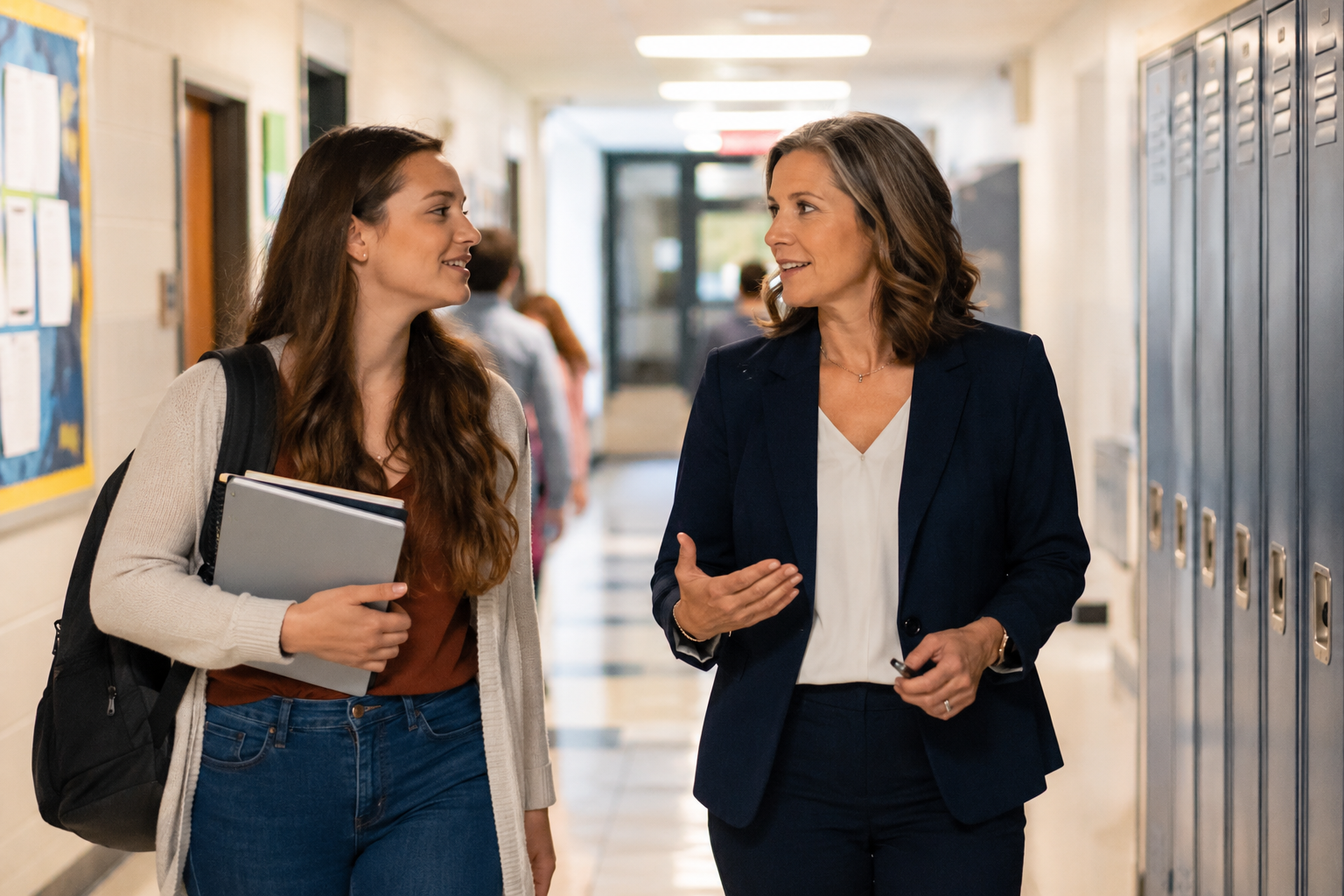
A principal’s work starts before the first bell. Students arrive with different strengths, needs, hopes, and struggles. Teachers need support. Parents need confidence. The school must be safe, orderly, and ready for real learning.
Principled school leadership helps bring those demands together. It gives principals a clear way to make hard decisions, explain them, and accept responsibility for what follows.
Start with a clear purpose
Principals make decisions all day, often without perfect information. A clear mission helps them decide what matters most.
The basic duties are simple: keep students safe and give them an excellent education. Every major decision should be tested against those goals. Will it improve teaching, protect students, respect parents, and support the school’s mission?
Clear standards will not make every choice popular. They will make the choice easier to understand.
Turn pressure into steady action
In our recent podcast conversation, we discussed how quickly a principal moves between instruction, discipline, staffing, facilities, budgets, and family concerns.
Heidi Udall, former principal of Heritage Academy Mesa, offered two useful ideas. Leaders should decide on their guiding standards before a crisis forces a quick choice. When the same problem keeps returning, they should build a system that solves it instead of fighting the same fire again.
Principals will still make mistakes. Good leaders admit them, correct the course, and learn from what happened.
Delegate and build systems
A principal should not try to do everything personally. That often leads to poor priorities and exhausted leadership.
Delegation means giving a capable person both the task and enough authority to complete it. It does not mean giving away final responsibility. The principal still owns the mission, school safety, personnel leadership, and major decisions.
Routine work should face a simple test: Can it be eliminated, automated, or delegated? Every few months, principals should review their calendars and ask what is taking time away from classrooms, teachers, parents, and planning.
Recurring work also needs clear systems. When fee collection, attendance, scheduling, or communication keeps causing trouble, leaders should clarify ownership, simplify the steps, and set firm deadlines.
Treat parents as partners
Parents hold the primary responsibility for raising their children. Schools serve families best when they respect that role and invite parents into an honest partnership.
A principal and a parent may see the same problem differently. Still, both can begin with the same question: What will best help this young person grow?
Families deserve a clear explanation when a decision is difficult. They should understand the reason, the expectation, and the next step. Schools build trust when they speak plainly and listen carefully.
Keep decisions close to the people
Local control means keeping responsibility near the people who understand the situation. Teachers, parents, staff members, and local boards often know details that a distant office cannot see.
The principal should set direction and protect the mission, but should not control every choice. Central offices still have an important role in safety, legal compliance, and basic standards. They should provide guardrails without removing sound local judgment.
Authority usually works best when it is limited, divided, and placed near the people affected by it.
Stay close to the classroom
Instructional leadership means helping teachers improve teaching and learning. A principal cannot do that only from an office.
Time in classrooms, hallways, and common areas helps leaders see what is really happening. It reveals problems early and shows how policies affect students, teachers, and families.
A 2015 Institute of Education Sciences review examined 52 studies on principals and student achievement. Several principal characteristics were linked with stronger results, but the evidence usually could not prove direct cause and effect. Leadership matters, but test scores do not show everything a good principal contributes.
Make character visible
Schools teach character every day, whether they plan to or not. Students watch how adults speak, prepare, keep promises, correct mistakes, and handle frustration.
If honesty matters, adults must tell the truth when it is inconvenient. If punctuality matters, leaders must arrive prepared. If respectful speech matters, correction must remain firm without becoming cruel.
In Federalist No. 55, James Madison argued that republican government requires both safeguards and a measure of trust. Human beings are imperfect, so power must be restrained. But self-government also depends on enough virtue for citizens and leaders to act responsibly.
Schools help build that capacity when they teach students to control their behavior, honor commitments, accept consequences, and respect the rights of others.
Protect the leader’s capacity
School leadership can consume every available hour. Over time, that can damage judgment and stability.
Principals need boundaries, trusted colleagues, mentors, and time to reflect. Rest often makes it easier to see a bad process, rethink a conflict, or return to a hard conversation with patience.
Strong leaders also remain teachable. Experience should produce humility, not complacency.
Form citizens, not only graduates
The purpose of principled school leadership is larger than running an efficient organization. A well-led school helps young people become responsible adults who understand freedom, duty, and self-government.
When schools uphold high standards, respect parents, delegate wisely, trust local judgment, and model personal responsibility, they strengthen civil society from the ground up. The principal sets the direction, but the whole school community must carry the work.
Further reading
- The Federalist No. 55 – National Archives (1788): https://founders.archives.gov/documents/Madison/01-10-02-0292
- A Systematic Review of the Relationships Between Principal Characteristics and Student Achievement – Institute of Education Sciences (2015): https://ies.ed.gov/use-work/resource-library/report/descriptive-study/systematic-review-relationships-between-principal-characteristics-and-student-achievement