
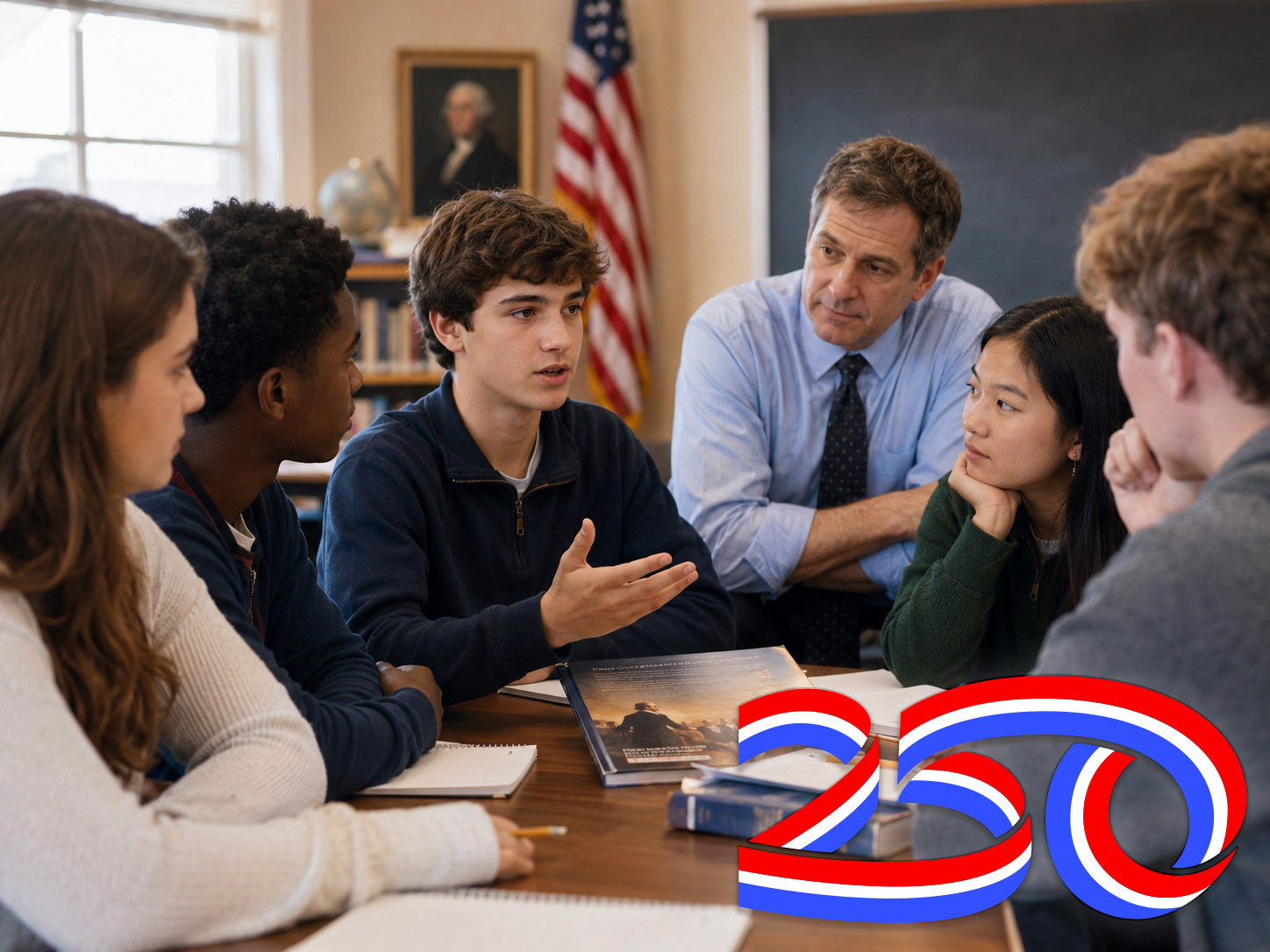
On July 4, 2026, the United States will commemorate the 250th anniversary of the signing of the Declaration of Independence. The national America250 effort describes the milestone as a time to reflect on the nation’s past, honor the contributions of Americans, and look ahead to the future we want to build together.
That makes the semiquincentennial more than a birthday celebration. It is an invitation to ask whether the habits that made self-government possible are still being taught, practiced, and defended.
Liberty needs character
The American experiment has always rested on a demanding idea: free people must be capable of governing themselves. Law matters. Institutions matter. Elections matter. But none of them can carry the weight of a republic if citizens lose the habits of honesty, restraint, responsibility, gratitude, and courage.
That concern was not foreign to the founding generation. George Washington’s Farewell Address linked public prosperity to the moral habits of the people. John Adams made a similar point when he warned that constitutional government depends on a citizenry capable of moral self-command. The point is not that every American must think alike. The point is that liberty requires more than slogans. It requires people who can tell the truth, keep promises, serve neighbors, and accept limits on their own appetites.
Those are not merely private virtues. They are civic virtues.
Rising generations are still asking the right questions
In a recent podcast conversation, Shane Krauser, a constitutional educator, attorney, author, and co-founder of Freedom Square USA, described a hunger among young adults to understand the principles behind ordered liberty. He has taught audiences in the United States and abroad, including Canada, Mexico, and Peru, and his work centers on the Declaration of Independence, the Constitution, and the proper role of government.
That matters because young people are not naturally hostile to freedom. Many are simply under-taught. They inherit a world full of information, but not always the framework needed to sort liberty from license, rights from preferences, or justice from resentment.
The challenge is not to tell students what to think. The challenge is to give them the tools to think clearly about human dignity, natural rights, consent of the governed, the rule of law, federalism, property, voluntary association, and ordered freedom.
Civic literacy is lagging
The urgency is measurable. According to the National Assessment of Educational Progress, only 22 percent of eighth-grade students performed at or above the NAEP Proficient level on the 2022 civics assessment. That result was not significantly different from 2018 or from 1998, the first year of the assessment. NAEP also reported that 69 percent of eighth-graders performed at or above Basic in 2022, down 3 percentage points from 2018.
Those numbers should bother anyone who cares about self-government. A student who cannot explain consent of the governed, separation of powers, federalism, equal protection, or the purpose of constitutional limits will have a harder time recognizing when liberty is being diluted. Civic ignorance does not remain neutral for long. It creates an opening for demagogues, bureaucratic drift, and fashionable slogans that sound compassionate while weakening responsibility.
Schools therefore have a serious duty. At Heritage Academy, civic education is not treated as a decorative subject. Students engage primary sources, discuss ideas through Socratic dialogue, and connect classroom principles with service and public responsibility. The goal is not memorized patriotism. The goal is thoughtful citizenship.
Prosperity grows where people are free to build
America’s rise cannot be reduced to geography, technology, or luck. Those things matter, but they do not explain the whole story. The deeper engine was a culture of ordered liberty: secure property, local initiative, voluntary exchange, religious and civic association, and limits on centralized power.
When people know their work will not be arbitrarily confiscated, they build. When families, schools, churches, businesses, and civic groups can act without waiting for permission from distant authorities, they solve problems. When local communities are trusted to govern much of their own life, citizens get practice in responsibility.
That is one reason local self-government matters. Town councils, school boards, civic associations, congregations, and parent communities are close enough to see real needs and correct mistakes quickly. Edmund Burke famously wrote of loving “the little platoon we belong to in society” as the first principle of public affection. Whatever one makes of Burke’s broader argument, the insight is still useful: people usually learn public virtue first in small, concrete communities.
Virtue is better than paternalism
When virtue weakens, paternalism becomes more tempting. If citizens cannot govern themselves, someone else will offer to govern them more tightly. That offer may come wrapped in the language of safety, equality, efficiency, or compassion. Sometimes it will address real problems. But when control replaces character, a society pays a price.
Government can punish crime, administer courts, defend borders, and protect rights. It cannot, by itself, create honest homes, disciplined students, generous neighbors, faithful friends, or courageous citizens. Those come from families, schools, churches, mentors, voluntary associations, and the daily practice of choosing what is right when no one is watching.
The semiquincentennial should therefore renew four habits:
- Teach founding texts early and often. Elementary students can begin with the Declaration’s claim that human beings are created equal. Older students can wrestle with federalism, enumerated powers, and constitutional interpretation.
- Pair knowledge with action. Service projects, city council visits, student debates, mock trials, and community problem-solving help move civic ideas from paper into practice.
- Strengthen families and voluntary associations. The household, the congregation, the club, the school, and the neighborhood are not side issues. They are where citizens are formed.
- Measure civic learning seriously. If we test math and reading because they matter, we should also care whether students understand the republic they are inheriting.
The flame belongs to us
America 250 asks a simple question: what kind of country will we hand to the next generation?
The answer will not come from Washington alone. It will come from parents, teachers, pastors, coaches, mentors, students, entrepreneurs, and neighbors who still believe freedom is worth the discipline it requires.
The founders risked fortune and life to declare that rights do not come from the crown. Their claim still challenges us. If we want our children to inherit liberty, we must teach them the principles that sustain it and model the virtues that make it believable.
The next 250 years will not be secured by nostalgia. They will be secured by citizens who understand freedom, love it, and are strong enough to live it well.
Further reading and source checks
- Freedom Square USA
- America250: national commemoration overview
- NAEP Civics: 2022 achievement-level results
- Shane Krauser: professional background
- George Washington’s Farewell Address, Avalon Project
- John Adams on morality and constitutional government, Online Library of Liberty
- Burke’s “little platoon” wording and context