
A healthy community does more than protect itself. It produces, serves, and builds. Families raise children with purpose. Schools cultivate knowledge and character. Businesses create value and opportunity. When these forces work in concert, they do more than fill jobs. They form citizens who can sustain a free society.
Workforce development, rightly understood, is not a narrow pipeline from classroom to paycheck. It is a broader formation of young people who understand their gifts, see real opportunities, and take responsibility for their future. If we reduce it to job placement alone, we miss its civic importance. If we get it right, we strengthen both our economy and our culture.
The Power of Exposure
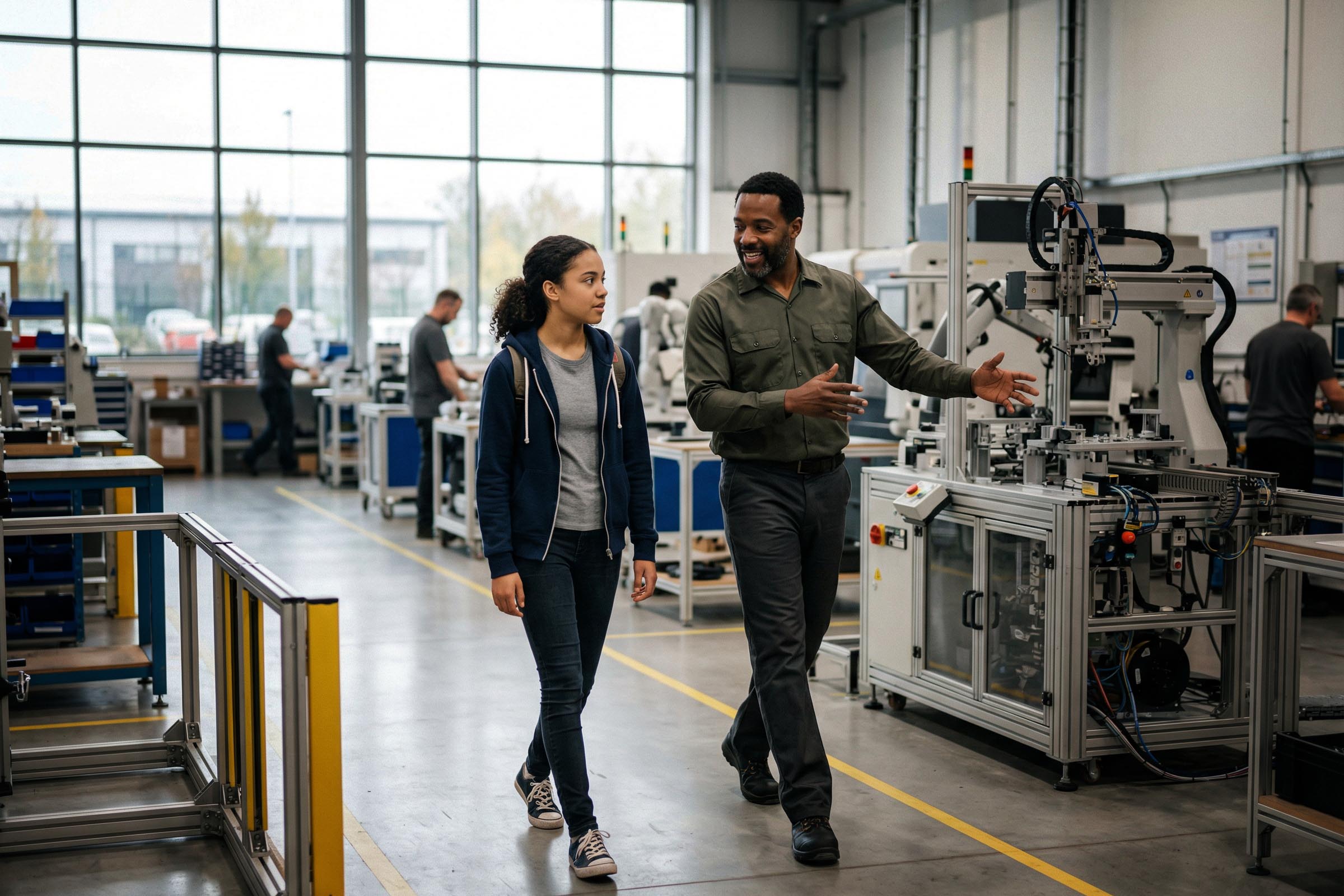
Young people cannot aspire to what they have never seen. One of the clearest lessons from our recent podcast conversation is that exposure is often the missing link. When students step inside a manufacturing plant, a small business, or a professional office, something changes. Work becomes tangible. Possibility becomes personal.
Career and Technical Education (CTE), defined as structured programs that prepare students for skilled trades and technical careers, has proven especially effective in this regard. Students who might not thrive in a traditional academic pathway often find purpose and momentum when they can build, repair, or create with their hands.
This is not a secondary path. It is a vital one. The dignity of work does not depend on whether it is done at a desk or on a shop floor. It depends on whether it serves others and is done well.
Business as a Civic Institution
We often speak of business in economic terms. But business is also a civic institution. At its best, it trains, mentors, and elevates people. It creates pathways for young adults to become providers, homeowners, and community leaders.
In our discussion, Sally Harrison, President of the Mesa Chamber of Commerce, emphasized that businesses are eager to participate when invited. Many are simply waiting to be asked. She noted that companies frequently open their doors for internships, classroom talks, and mentorship once schools initiate the connection.
She also highlighted a practical reality: many employers underestimate what younger students can legally and productively do in a workplace setting. Yet large firms have already demonstrated that, with the right structure, even high school students can contribute meaningfully and safely.
The lesson is straightforward. If it can be done, it should be done. And more often than not, it can be.
Internships: The Missing Middle
Internships occupy a critical space between education and employment. They allow students to test interests, build habits, and gain credibility. They also allow employers to identify and shape future talent.
Too often, we reserve internships for college students. That is a mistake. High school students benefit just as much, if not more, from early exposure to real work environments. Even short-term job shadowing can provide clarity that no classroom lecture can match.
Harrison pointed out that businesses consistently report positive experiences with young interns. They bring energy, curiosity, and fresh perspective. In some cases, they even influence how companies understand emerging markets and younger consumers.
This is not charity. It is mutual benefit.
The Role of Families and Schools
No system of workforce development can succeed without strong families and intentional schools. Parents remain the first guides in helping children discover their strengths. Schools provide the structure and opportunities to explore those strengths in a broader context.
One simple but powerful exercise discussed in our conversation involved helping students identify their interests through observation and reflection. Another emphasized asking trusted adults to identify a student’s strengths. These approaches reinforce a key principle: self-knowledge precedes wise decision-making.
Students should be encouraged to ask basic but essential questions:
- Do I enjoy working with my hands, my mind, or both?
- What kind of problems do I like to solve?
- When do I feel most energized by my work?
These questions are not academic. They are foundational.
Barriers We Can Remove
If the path forward is so clear, why do gaps remain? The obstacles are often practical rather than philosophical.
Transportation is one. In growing communities, jobs and schools are not always aligned geographically. Without reliable access, opportunities remain out of reach for many students.
Awareness is another. Schools may not know which businesses are willing to engage. Businesses may not know how to connect with schools. This is where local institutions, such as chambers of commerce, play a vital role as connectors.
Finally, there is hesitation. Some employers worry about liability or productivity when working with younger students. Yet these concerns are frequently resolved once programs are established and expectations are clear.
None of these barriers are insurmountable. All require local initiative rather than federal mandates.
A Free-Market Approach to Formation
The American system has always relied on voluntary association. Families, schools, churches, and businesses working together without excessive central control. Workforce development should follow that same pattern.
Local partnerships outperform distant directives because they are responsive to real conditions. A manufacturer knows what skills it needs. A school knows its students. A family knows its child. When these three communicate, solutions emerge naturally.
This aligns with a broader constitutional principle: that the most effective governance happens closest to the people. Education and workforce formation are no exception.
From Jobs to Purpose
The ultimate goal is not simply employment. It is purpose. A young person who understands his or her abilities, contributes meaningfully, and sees a future in the community is far more likely to build a stable and responsible life.
That outcome benefits everyone. It strengthens families, reduces dependency, and fuels economic growth.
As Harrison noted in our conversation, the most effective communities are those where people want to be involved in something larger than themselves. Workforce development, done well, invites young people into that larger story.
It tells them: you are needed here. Your work matters. Your future is worth building.
Further reading
- Career and Technical Education Programs and Outcomes — National Center for Education Statistics (2023): https://nces.ed.gov/programs/coe/indicator/ctb
- Apprenticeships: Earn While You Learn — U.S. Department of Labor (2024): https://www.apprenticeship.gov/