
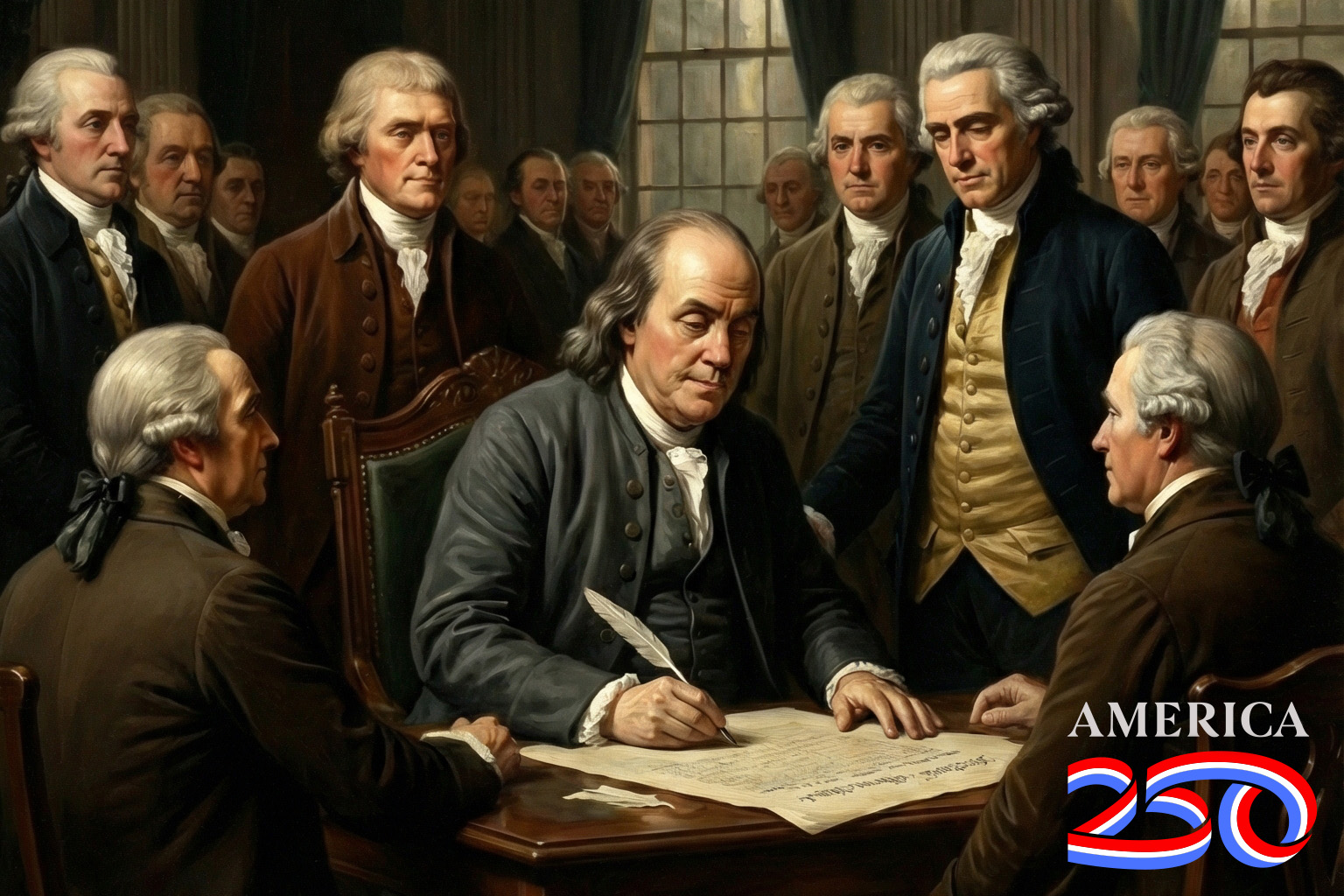
As America approaches her 250th birthday in 2026, we find ourselves at a crossroads not unlike the one our Founders faced in 1776. Then, it was a struggle for liberty. Today, it is a question of legacy. The task before us is not only to remember the courage that birthed our republic but also to ensure that the rising generation understands what it means to preserve and defend that liberty.
The Semiquincentennial is not a spectacle. It is a civic summons. And like all meaningful calls to duty, it begins with a story—a story of sacrifice, virtue, and conviction that must be taught well, lived out, and passed on.
Celebrating Civic Courage, Not Just Ceremonies
We do our students no favors when we present the founding era as a series of static dates or distant ideals. The events of 1776 were the result of real moral choices made by imperfect people who believed deeply in self-government. The Declaration of Independence was not merely a political statement—it was a pledge that cost lives, fortunes, and sacred honor.
The most urgent lesson from the Semiquincentennial is this: freedom is not free, and the responsibility of sustaining liberty lies with each of us. The 56 signers of the Declaration risked execution, not for gain, but for a principle. That is civic courage. We must help our students see that history is not made by heroes in marble but by ordinary citizens doing their part.
Honoring the Forgotten Patriots
As our guest Lynn Young, Commission Member of America250 and past President General of the Daughters of the American Revolution, emphasized in our recent podcast, the Revolution was won not only by generals and statesmen but by unnamed foot soldiers, women following the army camps, and allies on the frontier.
Too often, history curricula focus on a few elite figures and ignore the broader civic fabric. But the American story includes Spanish settlers in the Southwest supporting the revolutionary cause, young boys playing fifes and drums in New England militias, and women who foraged, cooked, and nursed troops. They, too, were patriots.
The same is true today. Civic virtue isn’t reserved for elected officials. It belongs to parents who raise principled children, students who volunteer in their communities, and teachers who teach the Constitution with clarity and conviction.
Why Service Still Matters
The America250 initiative has launched a national effort to record community service hours through its “America Gives” campaign. It is more than a number. It is a signal to our children that civic engagement begins at home.
John Adams once said the real revolution was in “the hearts and minds of the people.” That remains true. The surest way to cultivate love of country is not through lectures, but through local acts of service—helping a neighbor, participating in a school project, volunteering at a food drive. These are not distractions from education; they are its fulfillment.
Local Lessons, National Renewal
In a time of cultural division, the Semiquincentennial provides a rare opportunity to recenter our civic discourse around what unites us: a belief in self-government, a reverence for the Constitution, and a commitment to ordered liberty.
Our schools play a central role in this. With resources from institutions like the National Archives, the Library of Congress, and America250.org, educators can bring founding principles alive through primary sources, historic field trips, and student projects like “America’s Field Trip,” which invites creative responses to the question: What does America mean to you?
One of the most promising features of the celebration is the mobile “Freedom Truck,” a traveling exhibit of national artifacts designed to visit every state. When students see the original Declaration or walk through a re-creation of a Revolutionary War encampment, history becomes personal—and patriotism, tangible.
The Goal Is a More Virtuous Republic
The founders sought “a more perfect union,” not a perfect one. They knew liberty required ongoing effort. As parents, educators, and citizens, our role is to teach the habits of self-governance: courage, service, gratitude, and a deep knowledge of our constitutional framework.
Parental partnership is vital in this effort. Schools cannot instill civic character alone. But when families and educators work together—telling the whole truth of our founding, modeling service, and valuing place-based learning—we do more than commemorate 250 years. We prepare the next generation to carry them forward.
Let this anniversary be more than fireworks and speeches. Let it be a national civics lesson. Let it remind us that liberty, once earned by blood, must be maintained by character. And let our young people say, in 2076, that we rose to the occasion.
Further reading
- American Principles and Virtues — Bill of Rights Institute (n.d.): https://billofrightsinstitute.org/lessons/american-principles-and-virtues/
- Civics Education in Public Schools: Lessons and Activities Around the 2024 Election — National Center for Education Statistics, Institute of Education Sciences (2024): https://nces.ed.gov/learn/blog/civics-education-public-schools-lessons-and-activities-around-2024-election